How voice-cloning scams work
- Collect a voice sample. A few seconds of audio from a social-media video, a voicemail greeting or a phone call is often enough.
- Clone it. Widely available AI tools turn that sample into a voice that can say anything.
- Create an emergency. An accident, an arrest, a kidnapping, an urgent business deal — anything that triggers panic.
- Demand fast, unusual payment. A bank transfer to a new account, gift cards, crypto or a courier picking up cash — and a request to keep it secret.
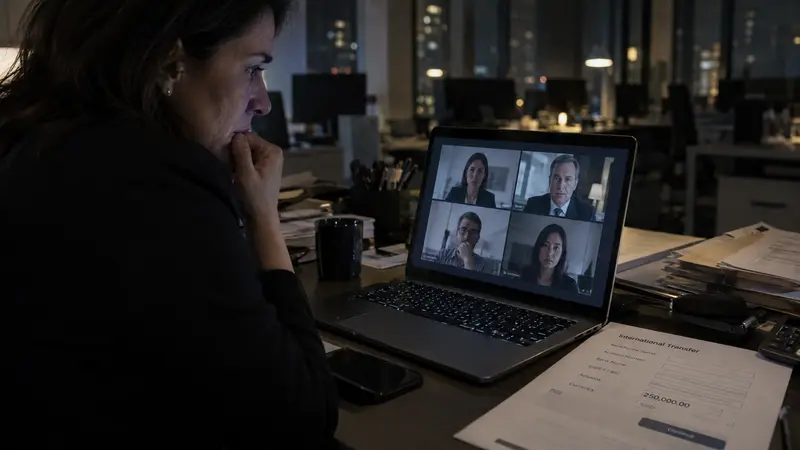
The same technique targets businesses: fake calls or video calls from a “CEO” or “CFO” asking finance staff to make urgent transfers. In one 2024 case in Hong Kong, an employee transferred about US$25 million after a video call in which every other participant was a deepfake (CNN).
The warning signs
- Urgency: you must act now, before you can think or check.
- Secrecy: “don’t tell anyone”, “don’t call Dad”, “this is confidential”.
- Unusual payment: gift cards, crypto, a new account, cash pick-up.
- A new or hidden number: “my phone broke”, “I’m calling from a friend’s phone”.
- Avoiding questions: the caller changes the subject or gets upset when you ask something personal.
Any two of these together: stop.
Five habits that defeat almost every voice scam
- Agree on a family safe word — a word only your family knows, to be used in any real emergency. No word, no money.
- Hang up and call back on the number you already have saved. A real emergency will still be real in two minutes.
- At work, verify every payment request through a second, known channel — no matter who seems to be asking.
- Limit public voice and video of yourself and your children where you reasonably can, and make social accounts private.
- Set up bank protections — transfer limits, alerts, and a “trusted contact” for older relatives.
Practise the reflex: our game Scam Call puts you in these situations with a 20-second timer.
Who is most at risk?
Anyone can be targeted. Scammers often go after older people (the “grandparent scam”), parents of teenagers and young adults, and finance staff at companies of every size. People who post a lot of video online give scammers more voice material to work with.
If you think you’ve been scammed
- Call your bank immediately — every minute counts for stopping or recalling a transfer.
- Report it to the police and to your national fraud-reporting service (for example the FTC in the US at reportfraud.ftc.gov, or Israel’s National Cyber Directorate hotline 119).
- Warn your family and contacts — scammers often try the same trick on others.
- Don’t be ashamed. These scams are designed by professionals to fool smart people.
Frequently asked questions
How much audio does a scammer need to clone a voice?
Often only a few seconds of clear speech, such as a short social-media video or a voicemail greeting. More audio makes a better clone, but a short sample can be enough to fool a panicked listener.
What is a family safe word?
A secret word or phrase agreed in advance by your family. In any real emergency call, the caller must say it. Scammers cloning a voice will not know it.
Can a video call be faked too?
Yes. Real-time face-swap tools can make a scammer appear as someone else on a video call. Seeing a face is no longer proof of identity when money is involved.
Will my bank refund me if I was tricked?
It depends on your country, your bank and how the payment was made. Contact your bank immediately — the faster you report, the better the chance of stopping the money.
What do you think?
Share your experience or your worries with the community — or see what everyone fears most in our live poll.